
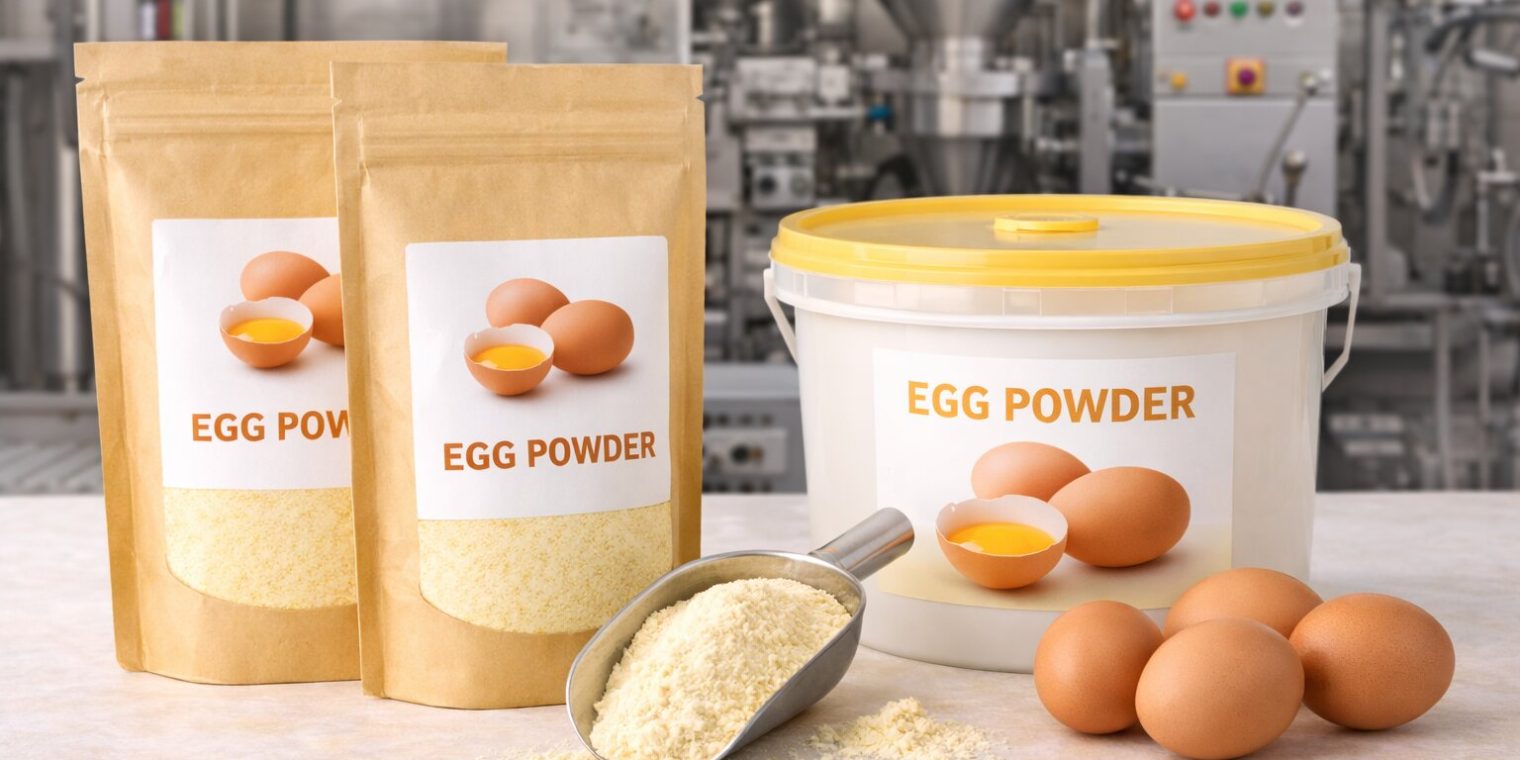
Shelf-stable egg powder for industrial food production
Egg powder is a processed egg product designed for food manufacturing environments where stability, safety and operational efficiency are critical. By removing the water content from liquid eggs, producers obtain a concentrated ingredient that retains the functional and nutritional properties of fresh eggs while offering a significantly longer shelf life and easier handling. For industrial food production, this format solves several logistical and technological challenges that occur when working with shell eggs or even liquid egg products.
Egg powder is produced from high-quality eggs that undergo several controlled processing stages. First, the eggs are cleaned, broken and separated if necessary into whole egg, yolk or egg white. The liquid egg is then filtered and pasteurized to eliminate pathogenic microorganisms. After pasteurization, the product is transformed into powder using spray-drying technology. During this process the liquid egg is atomized into fine droplets and exposed to hot air in a drying chamber. Moisture evaporates almost instantly, leaving behind a fine powder that preserves the functional characteristics of the original egg.
One of the main advantages of egg powder in industrial food production is its extended shelf life. Fresh eggs and liquid eggs are highly perishable and require strict refrigeration during transport and storage. Egg powder, in contrast, contains very little moisture, which significantly slows microbial growth and chemical degradation. When stored in sealed, moisture-protected packaging under appropriate conditions, egg powder can remain stable for many months. This makes it particularly valuable for large-scale food manufacturers that require long-term ingredient availability and predictable supply chains.
Logistics and storage efficiency are also major benefits. Shell eggs occupy large volumes and require careful handling to avoid breakage. Liquid eggs require refrigerated tanks and controlled transport conditions. Egg powder dramatically reduces storage space because the water content has been removed. A smaller quantity of powder can replace a much larger volume of liquid egg. This allows food factories to store large production volumes without expanding cold storage infrastructure.
Another operational advantage is consistency. Food manufacturers require ingredients with stable functional properties. Egg powder provides standardized performance in baking, emulsification, foaming and binding applications. Because the product is produced under controlled industrial conditions, manufacturers receive a consistent ingredient batch after batch. This reduces variability in final food products and simplifies process control in automated production lines.
Egg powder is widely used across many segments of the food industry. Bakeries rely on it for cakes, cookies, pastries and bread products where eggs provide structure, color and flavor. In pasta manufacturing it contributes to texture and nutritional value. In sauces and dressings egg components act as emulsifiers, helping oil and water phases remain stable. The confectionery industry uses egg powder in marshmallows, meringues and fillings because of its ability to create stable foams. Prepared food manufacturers also use it in ready meals, mayonnaise, snack coatings and processed meat products.
From a production efficiency perspective, egg powder eliminates several labor-intensive steps associated with shell eggs. Industrial kitchens and factories do not need to wash, break or separate eggs. There is no shell waste to manage and no risk of shell fragments entering the product stream. The ingredient arrives ready to use and can be dosed precisely according to recipe requirements. This improves hygiene, reduces preparation time and simplifies quality control.
Food safety is another important factor. During processing, liquid eggs undergo pasteurization, which reduces microbial risks. Spray drying further reduces water activity, creating conditions that are unfavorable for bacterial growth. Combined with sealed packaging and proper storage, egg powder becomes a safe and reliable ingredient for large-scale food manufacturing.
In many industrial recipes, egg powder is reconstituted with water before use. When mixed in the correct proportions, the resulting liquid performs similarly to fresh eggs. This flexibility allows manufacturers to adapt the ingredient to a wide variety of production systems, whether they require liquid mixtures, dry blends or premixes for instant food products.
Modern egg powder production is supported by strict quality control procedures. Each batch is tested for microbiological safety, moisture levels and functional performance. Producers also monitor parameters such as color, protein content and solubility to ensure the ingredient meets food industry standards.
For food manufacturers seeking stability, safety and operational efficiency, egg powder offers a practical alternative to traditional egg formats. Its long shelf life, reduced storage requirements and consistent functional properties make it a valuable ingredient across many sectors of the food industry. As demand for scalable food production continues to grow, shelf-stable egg powder remains an essential component in modern industrial food processing.