
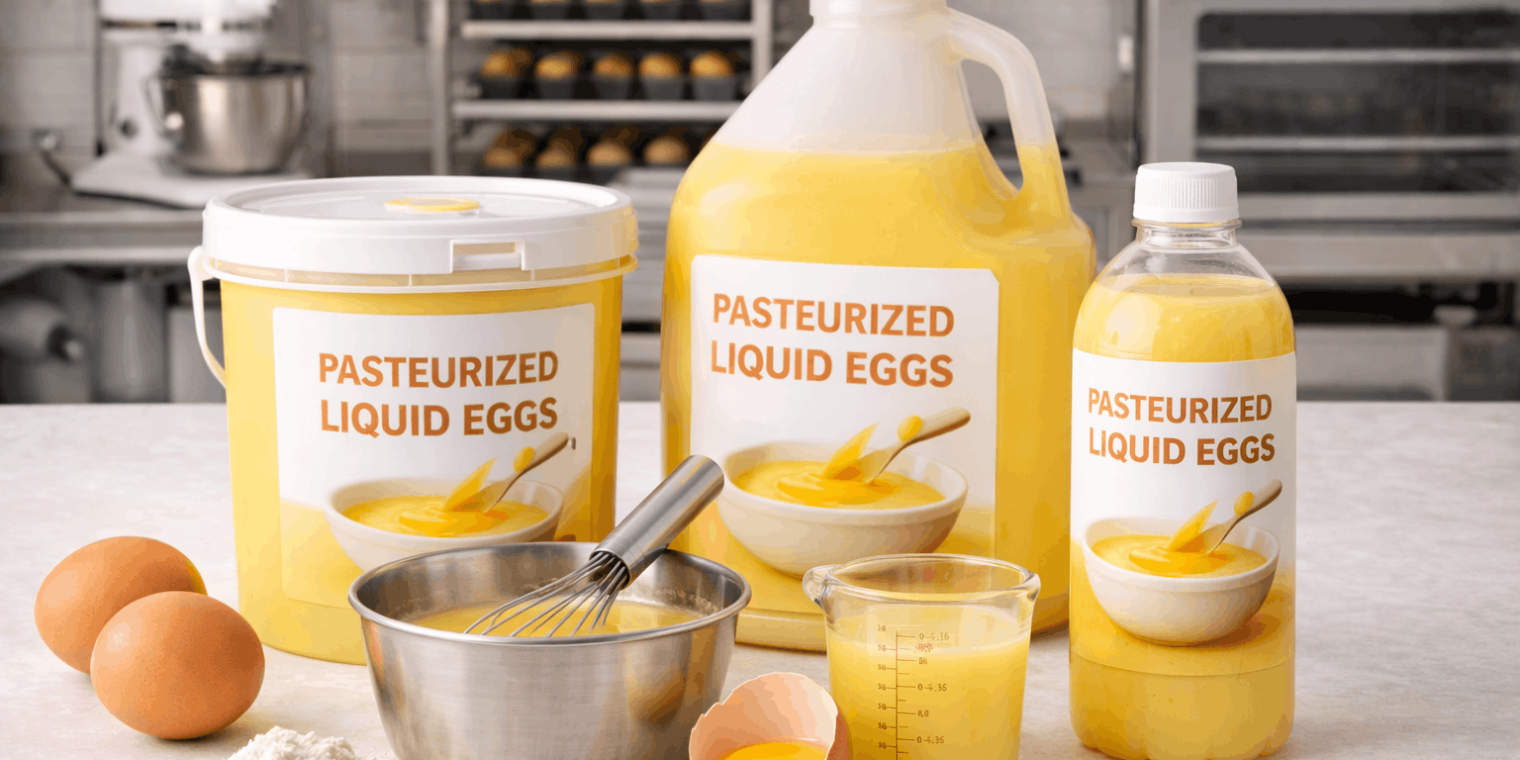
Pasteurized liquid eggs for bakeries, food factories and professional kitchens
Pasteurized liquid eggs are a modern egg product designed for professional kitchens and industrial food production. They provide the functional properties of fresh eggs while eliminating several operational challenges associated with shell eggs. In bakeries, food factories and large-scale catering operations, liquid eggs simplify preparation, improve hygiene and ensure consistent product quality.
Liquid egg products are produced from fresh eggs that undergo controlled processing to maintain safety and performance. The production process begins with carefully selected eggs that are cleaned and mechanically broken in specialized equipment. Depending on the product type, the eggs may remain as whole egg or be separated into egg yolk and egg white. The liquid mass is filtered to remove shell fragments and other impurities before entering the pasteurization stage.
Pasteurization is a critical step that improves the microbiological safety of the product. During this process the liquid egg is heated to a controlled temperature for a specific period of time, sufficient to destroy harmful microorganisms such as Salmonella while preserving the functional proteins of the egg. After pasteurization the product is rapidly cooled and packaged under hygienic conditions. This controlled process allows liquid eggs to be safely used in recipes that might otherwise require strict handling of raw eggs.
One of the most important advantages of pasteurized liquid eggs is convenience. Professional kitchens and food factories no longer need to manually break and separate thousands of eggs. The ingredient arrives ready to use and can be measured directly according to recipe requirements. This significantly reduces preparation time and labor costs while also minimizing the risk of shell contamination.
For bakeries, liquid eggs offer reliable and consistent performance in doughs and batters. Eggs play a central role in many bakery products by providing structure, moisture and color. The proteins in eggs help stabilize doughs and batters, while the yolk contributes emulsifying properties that improve texture and flavor. Because liquid eggs are produced under standardized industrial conditions, bakeries can rely on consistent functionality from batch to batch, which is especially important for large-scale production.
Food manufacturing facilities also benefit from the efficiency of liquid egg products. In automated production lines, ingredients must be easy to pump, mix and dose accurately. Liquid eggs can be delivered through closed piping systems directly into mixing equipment, eliminating manual handling. This improves process control and helps maintain hygienic production environments.
Professional kitchens and catering services use pasteurized liquid eggs in a wide range of culinary applications. Breakfast preparation, omelets, scrambled eggs, sauces and desserts can all be produced more efficiently when eggs are supplied in liquid form. Large hotels and catering operations often prefer liquid eggs because they simplify storage and reduce waste. Instead of managing large quantities of fragile shell eggs, kitchens can store liquid eggs in containers designed for easy pouring or pumping.
Another advantage of liquid eggs is food safety. Shell eggs can sometimes carry bacteria on the shell surface, which may be transferred during handling. Pasteurized liquid eggs significantly reduce this risk because the heat treatment destroys harmful microorganisms before the product reaches the kitchen or factory. This makes liquid eggs particularly valuable in institutional kitchens such as hospitals, schools and large catering facilities where strict food safety standards must be maintained.
Storage and packaging formats can vary depending on customer needs. Liquid eggs may be supplied in cartons, bag-in-box containers or large industrial tanks. Refrigeration is required to preserve freshness and maintain product quality. When stored under proper conditions, pasteurized liquid eggs maintain their functional properties for an extended period compared to raw shell eggs after cracking.
Liquid egg products are available in several forms to suit different food production processes. Whole liquid egg is commonly used in general baking and cooking applications. Liquid egg whites are valued for their foaming properties in meringues, desserts and protein-rich products. Liquid yolks are often used in sauces, dressings and confectionery where emulsification and color are important.
For bakeries, food manufacturers and professional kitchens that require efficiency, safety and consistency, pasteurized liquid eggs represent a practical and reliable solution. By combining the natural functionality of eggs with modern processing technology, liquid egg products support large-scale food production while maintaining the quality expected from traditional egg ingredients.